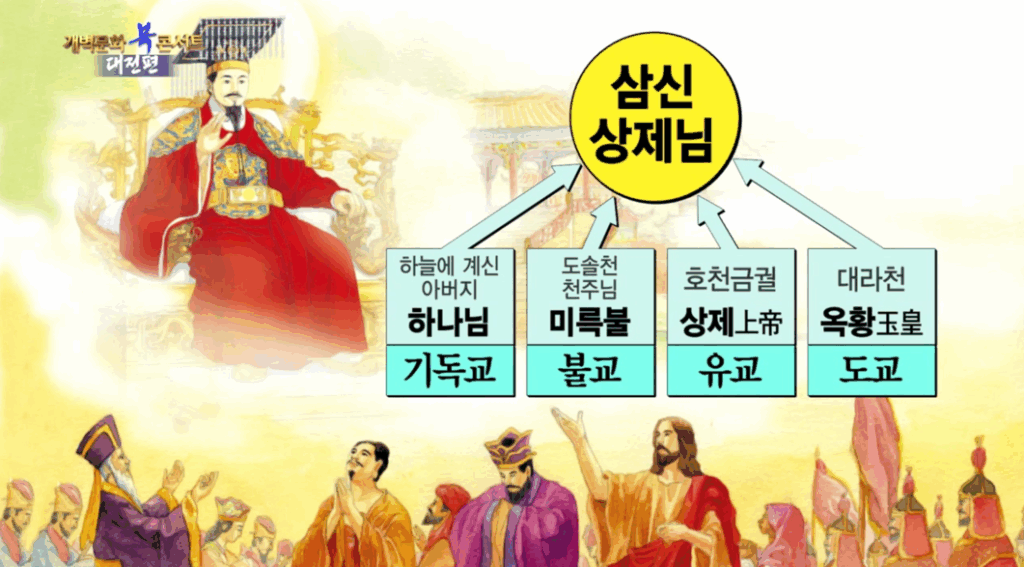
For millennia, humanity has walked diverse spiritual paths. Seondo (Taoism), Buddhism, Confucianism, and the Western path of Christianity have all served as the foundational roots for the cultures of people across the globe. While their teachings and rituals may seem distinct, they all share a common thread: a prophetic vision of a future savior, a final conclusion to their spiritual journeys.
What if these seemingly separate prophecies all point to the same, single divine being?
According to the teachings of Jeung-san Do, the great sages of history—Confucius, Shakyamuni Buddha, and Jesus—were sent to the world by a higher authority to lay the groundwork for a new era. Each tradition has been waiting for a promised figure:
- Christians await the second coming of Jesus.
- Buddhists await the arrival of Maitreya Buddha.
- Followers of Donghak await the rebirth of its founder, Choe Su-un.
The prophecy states that when this one person arrives, all will recognize him as their true teacher and follow him. This prophesied savior is Sangjenim, the Supreme God, who declared, “When they say that Jesus will return, it is me they are talking about.”.
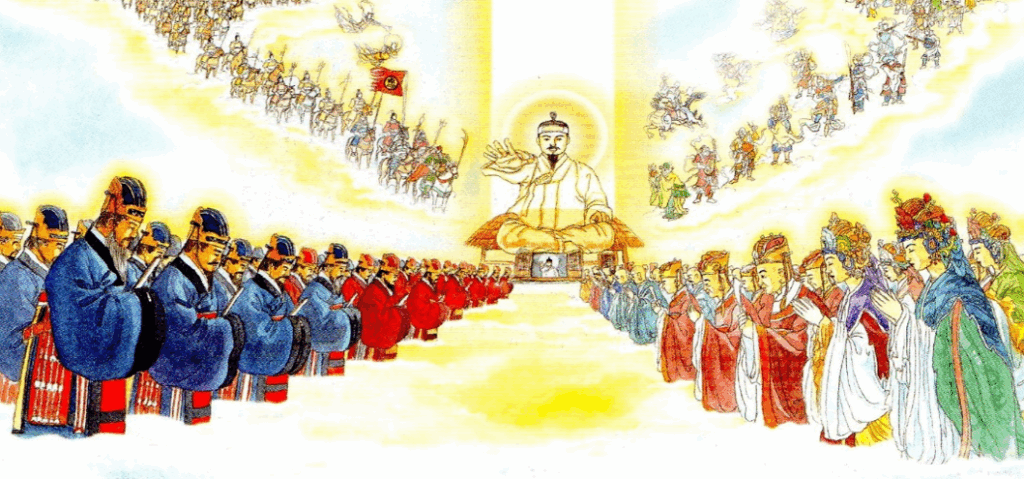
The Conclusion of Christianity: Awaiting God the Father
Christianity’s journey can be seen as a progression from the Old Testament (舊約) to the New Testament (新約), culminating in the “Completed Testament” (成約). Jesus’s core message was not about himself, but about the one who sent him.
- He Testified to the Father: Jesus taught that a Father God exists in heaven and that His kingdom was near. He repeatedly clarified that he did not come of his own accord but was sent by the Father.
- He Lived for the Father’s Will: Jesus’s mission was to carry out the Father’s will, not his own. He stated clearly that only those who do the will of the Father in heaven will enter the kingdom of heaven.
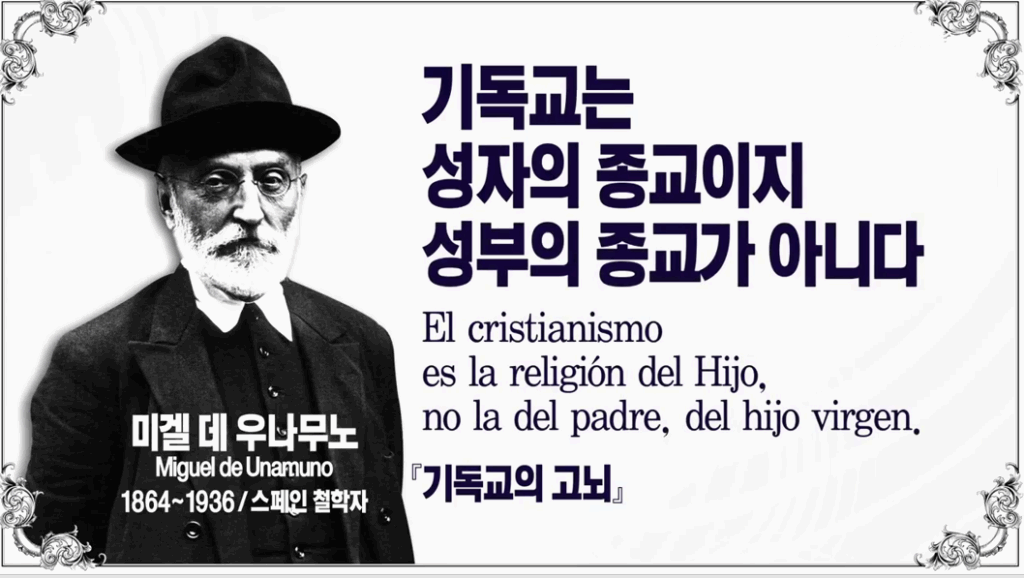
However, this original message became distorted. The Apostle Paul, who wrote 13 of the 27 books of the New Testament, heavily influenced Christian doctrine. While his devotion was profound, his focus on the return of Jesus inadvertently shifted Christianity’s focus from God the Father to God the Son, a development that Spanish philosopher Miguel de Unamuno noted by stating, “Christianity is the religion of the Son, not of the Father.”.
The Book of Revelation, however, brings the focus back to the Father. It speaks not of Jesus, but of “one who was seated on a great white throne,” who declares, “Look, I am making everything new.”. This being is described as the “Alpha and Omega, who is and who was and who is to come, the Almighty.”. Christianity, therefore, was the religion that prepared the world for the coming era of God the Father.
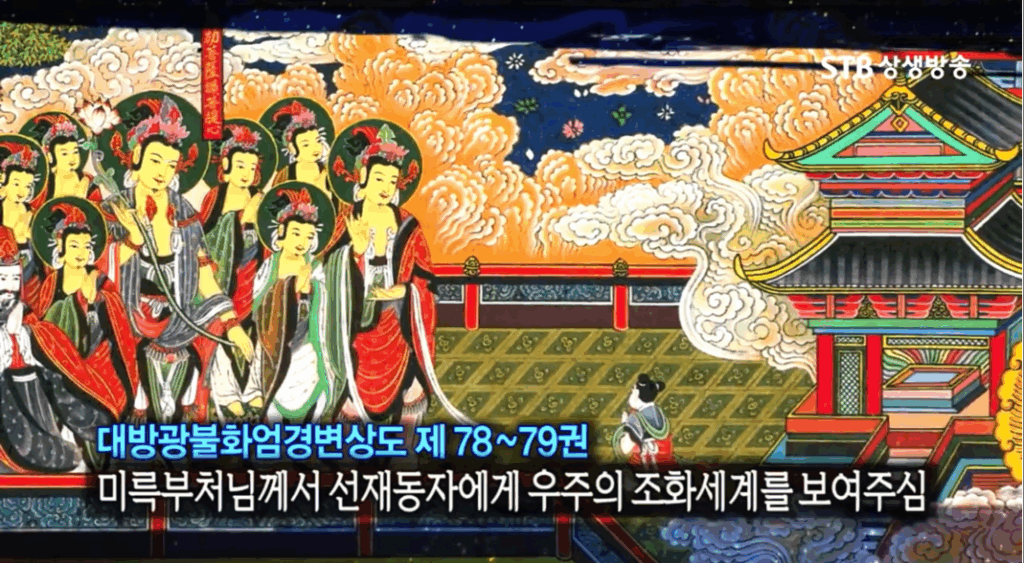
The Conclusion of Buddhism: Maitreya, the Buddha of the Future
Buddhism’s final conclusion is that in the era of the End of Dharma (末法), Maitreya Buddha will arrive. Buddha’s final sermon outlined the ages of his teachings, predicting a time when his Dharma would decline, giving way to the coming of a new savior.
Maitreya is known as the Buddha of the future, a savior who will establish the idyllic Yonghwa Paradise on Earth. He is prophesied to appear during the End of Dharma, 3,000 years after Shakyamuni’s passing, to heal a diseased world and save all humanity. The Lord of Tushita Heaven is called Maitreya, and it is to him that all beings should turn.
This hope has been kept alive for centuries.
- Asanga (Mochak): This great Buddhist thinker of the 4th century systematized the Vijnapti-matrata (Yogacara) school of thought. After 12 years of intense spiritual practice, he finally met Maitreya Buddha and received the teachings that would become foundational texts, preparing the world to receive Maitreya’s truth.
- Monk Jinpyo: In the Silla Dynasty of Korea, the monk Jinpyo dedicated his life to preparing for Maitreya’s coming, culminating in the construction of the Maitreya Hall (Mireukjeon) at Geumsan Temple in 762 AD.
Sangjenim declared a direct connection to this prophecy, stating, “I am Maitreya.”. He further explained, “The Maitreya statue at Geumsan Temple holds a yeouiju (wish-fulfilling jewel) in its hand, but I hold it in my mouth… If you wish to see me, look upon the Maitreya Buddha at Geumsan.”. Thus, the Lord of Tushita Heaven, Maitreya, is none other than Sangjenim.
The Conclusions of Confucianism and Taoism
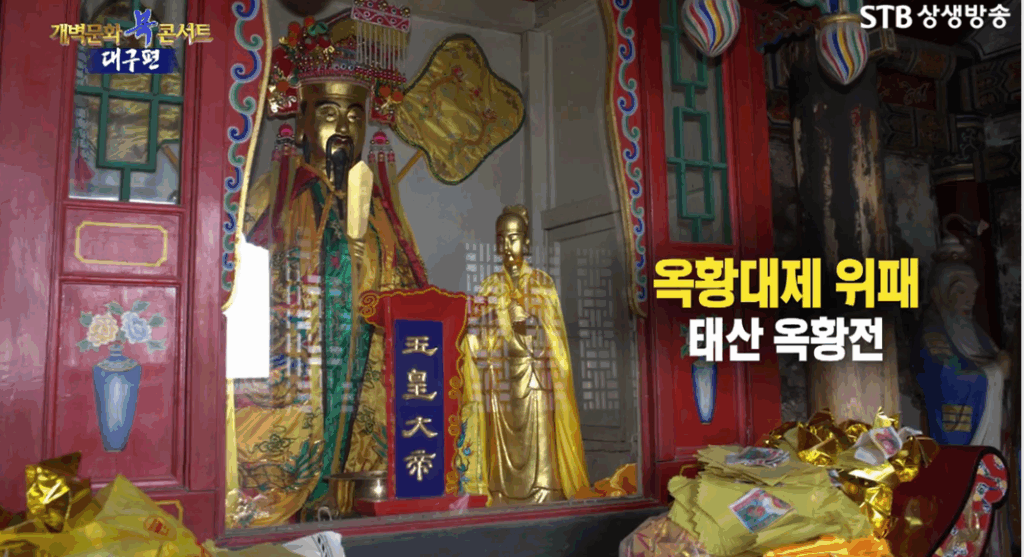
Confucianism: The original foundation of Confucianism is the culture of serving Sangje (上帝), the Supreme God. Classical texts like the Shijing (Book of Odes), Shujing (Book of History), and Zhouyi (I Ching) all contain references to this supreme heavenly ruler. The great Neo-Confucian scholar Zhu Xi stated that the Ruling God, Je (帝), is the same as the Great Jade Emperor (옥황상제). Crucially, the Zhouyi prophesied that “The Emperor comes forth from the East (帝出乎震)” and “The Word is accomplished in the Northeast (成言乎艮).”. This Northeast direction, Gan (艮), points directly to the Korean peninsula, where the transformation of nature and civilization will be concluded and begin anew.
Taoism: The conclusion of Taoism is that at the center of the 33 layers of heaven is a celestial realm called the Daeracheon, where the Jade Emperor (Ok-hwang-sang-je) resides.
When viewed together, a clear picture emerges: The future savior of Buddhism, Maitreya—the Lord of Tushita Heaven—and the supreme ruler of Taoism, the Jade Emperor, are the same being.
The Final Declaration: Donghak’s “Sichonju”
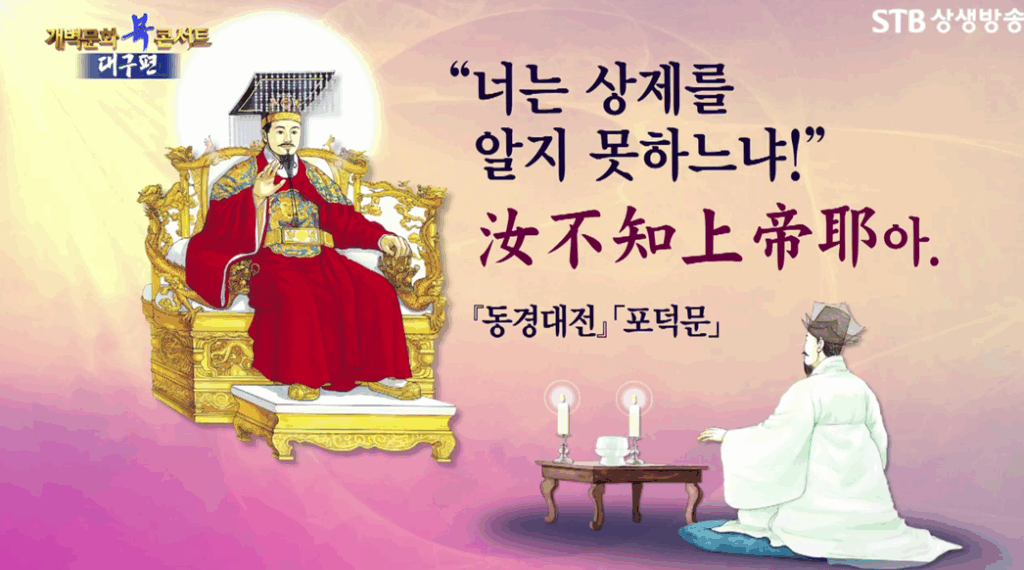
The final and most direct proclamation of Sangjenim’s arrival came through Donghak (“Eastern Learning”) in Korea. Its founder, Choe Su-un, experienced a profound revelation in 1860, where a divine voice asked him, “Do you not know Sangje?”. The core teaching he received was Sichonju (侍天主), which means, “Bear the Lord of Heaven, for he is incarnating as a human, and through this a new world of creation is established.”. It was a direct announcement that the age of the Son was ending and the age of the Father was beginning, with the arrival of Sangjenim and the emergence of the Mugeuk-daedo (Way of the Supreme Ultimate).
Sangjenim himself affirmed this, stating, “The Donghak mantra ‘Sichonju Jowhajeong’ refers to My work… My teaching is the true Donghak.”.
The Advent of the One True God
The history of the previous era—the cosmic spring and summer—was a long, arduous preparatory period for humanity to finally receive the true God. That one, identical being prophesied by all great religions came to the world in 1871, in the land of Korea, as Jeung-san Sangjenim.
He came with the surname Kang (姜), which he explained is the “primordial surname,” signifying a return to the origin (原始返本, wonsi-banbon) in this age of Gaebyeok, the Great Opening.
Holding the authority over the entire universe, Sangjenim personally initiated the Cheonji Gongsa (天地公事)—the Work of Renewing Heaven and Earth. He declared, “Now I am reconstructing heaven and earth, building a water-tight framework of dosu (degree), so that a new order will unfold as each event reaches its designated degree.”.
The saints and sages of the past were sent by the Father and acted on His mandate. But in this era, Sangjenim declared, “I have come down myself.” All previous paths and teachings were laid out for his use, to be unified and brought to fruition in this, the cosmic autumn. Now is the time to find the path of the Father, who is governing this great cosmic transition from summer to autumn.